Next.js · Storefront · live · 2025
Hitech Infovision
Storefront and admin panel for a computer-hardware shop in Nehru Place, built during an internship. Custom design system, server-side prices, WhatsApp enquiries.
- Problem
- A Nehru Place hardware shop needed its catalogue online and a way to run it without a developer.
- What I built
- A server-rendered storefront with WhatsApp enquiries, plus an admin panel for products, prices, discounts and services.
- Outcome
- Live at hitechinfovision.com with the shop's real inventory.
- Role
- Lead developer, as a Web Development & Security Intern
Tech: Next.js 16, TypeScript, Supabase, PostgreSQL, Tailwind CSS, Zod
Repository · Live · Case study
What it is
Hitech Infovision is a computer-hardware shop in Nehru Place, New Delhi. I built its website during an internship: a storefront for customers and an admin panel for the owner. It's live at hitechinfovision.com.
The shop needed three things. It needed to show up in search, because the old web presence had inconsistent branding, slow pages and outdated URLs. Customers needed an easy way to ask about specific, expensive parts. And the owner needed to update products, prices and shop details without calling a developer.
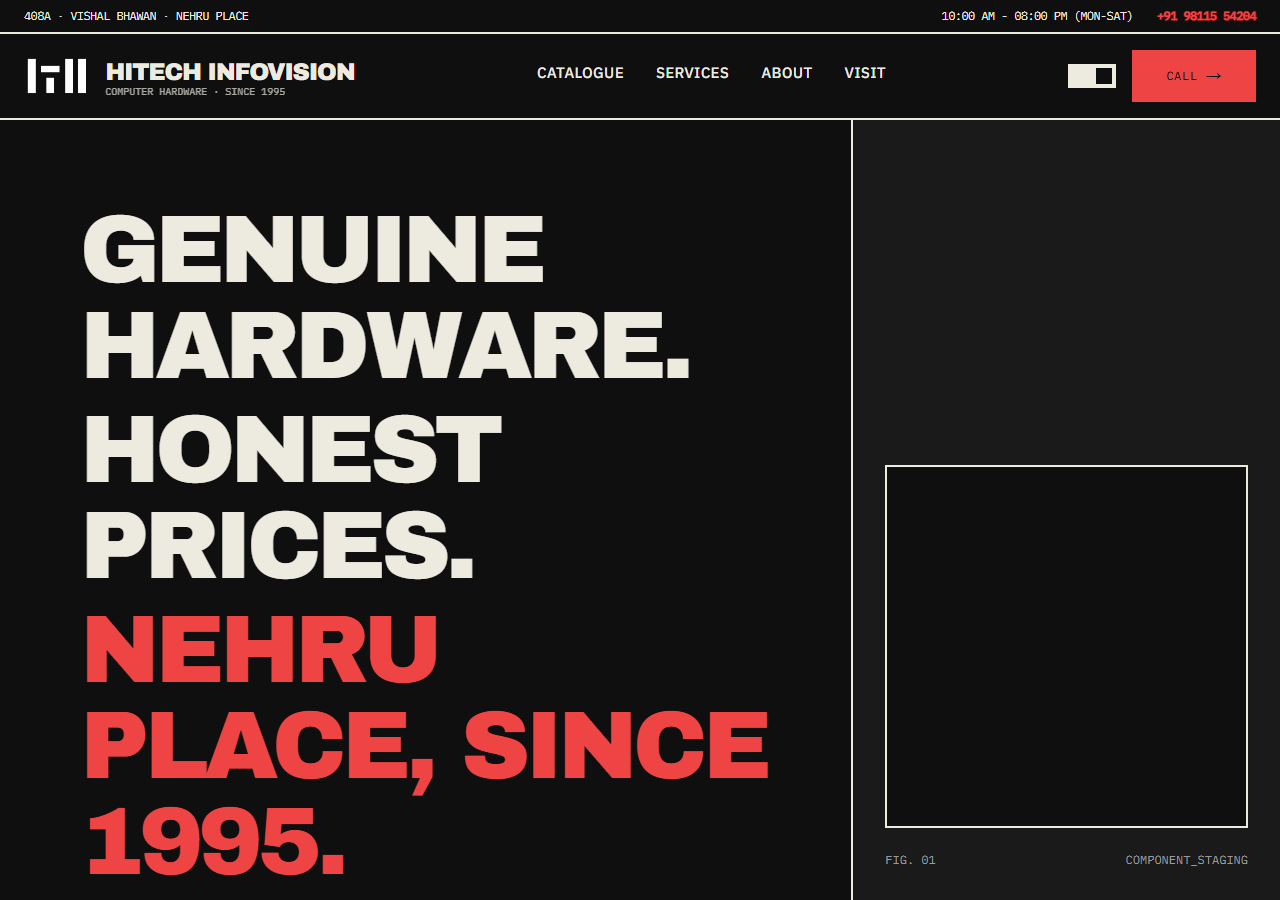
What I built
I was the lead developer on the project.
- Storefront. A product catalogue with search and filters for category, brand and price. Each product page has an image gallery, a spec table and an availability badge.
- WhatsApp enquiries. An "Enquire on WhatsApp" button pre-fills the product details. On mobile there are one-tap call buttons.
- Admin panel. The owner manages products, categories, prices, time-limited discounts, coupons, services and shop details such as hours and contact info.
- Audit trail. Every admin change is recorded in a log that can only be appended to.
How it works
It's a Next.js App Router site with React Server Components, TypeScript, Tailwind CSS v4 and Supabase, deployed on Vercel. Pages render on the server and arrive ready, with no loading spinners.
Prices are worked out on the server. The browser never decides what a customer is charged. Prices are stored in paisa to avoid floating-point rounding, and inputs are validated with Zod. The site also sets the usual security headers.
A good share of the work was SEO. Every product and category gets its own title, description and canonical tag. Structured data lets search results show price, availability and brand. Old filter URLs were turned into clean paths, with redirects so existing links keep working. The sitemap updates as products are added, and social preview images are generated on demand so a shared link shows the current name and price.
Design
I built the design system from scratch, with no component library and no icon library. It borrows from old technical manuals and Swiss industrial catalogues: sharp corners, hard rules, one signal red, and monospace for every number. Dark mode follows the system setting. Working inside those limits pushed me to solve problems with type and layout instead of adding widgets.
What's limited
I don't have measured before-and-after numbers for traffic or search ranking, so I'm not putting any here. The source code is private because this is a live client site. The public repositories hold a summary and a case study.
Links
- Live site: hitechinfovision.com
- Public summary: github.com/euphoric-habromaniac/hitechinfovision.com
- Case study: github.com/euphoric-habromaniac/hitech-infovision-case-study